Explore the serious risks of falls and functional decline in ageing parents, and discover effective strategies to enhance their quality of life and independence.
What makes the difference between your parents enjoying their golden years or spending those years in disability and/or pain? Fall and injury prevention split the difference between how independent and pain-free we are in the later decades of our lives. We only get one body (although sometime new parts) and we need to make sure that runs well for the long-haul and is resilient to changes.
We never know when we're going to trip or fall next. Accidents happen when we least expect them, usually at the most inopportune times, joining death and taxes on the list of life's inevitabilities. What turns an accident into an emergency is severity: whether something is broken, torn, or shattered. A bad fall, one that severely limits mobility and the ability to manage daily activities, can permanently diminish our parents' quality of life. Throughout this article, we explore how falls affect our parents' mobility, independence, and quality of life, and what the evidence says we can actually do about it.
A hip fracture can turn an adult child into a full-time caregiver overnight. Whether it's walking down Hong Kong's many urban inclines or tripping over clutter inside, falls can affect our parents' mobility, mental health, and long-term health outcomes. After a hip fracture: more than 30% of patients cannot walk independently after recovery and about 25% die within one year [1].
Muscle loss, reduced strength and poor balance can increase fall risk, while bone loss affects how likely a fall is to cause a fracture. Falls can also be influenced by medication, vision, dizziness, pain, footwear, home hazards, and gait and balance problems [37]. Falls are one of the leading causes of functional decline and death in older adults in Hong Kong.
The data is stark:
- According to the Hong Kong Elderly Health Service (2023), 15.7% of community-dwelling adults aged 65+ experienced at least one fall in the past year. Of those, 9.8% sustained a fracture [2].
- Over 6,300 older adults experience a hip fracture every year in Hong Kong. Falls are the cause of more than 95% of those fractures [3].
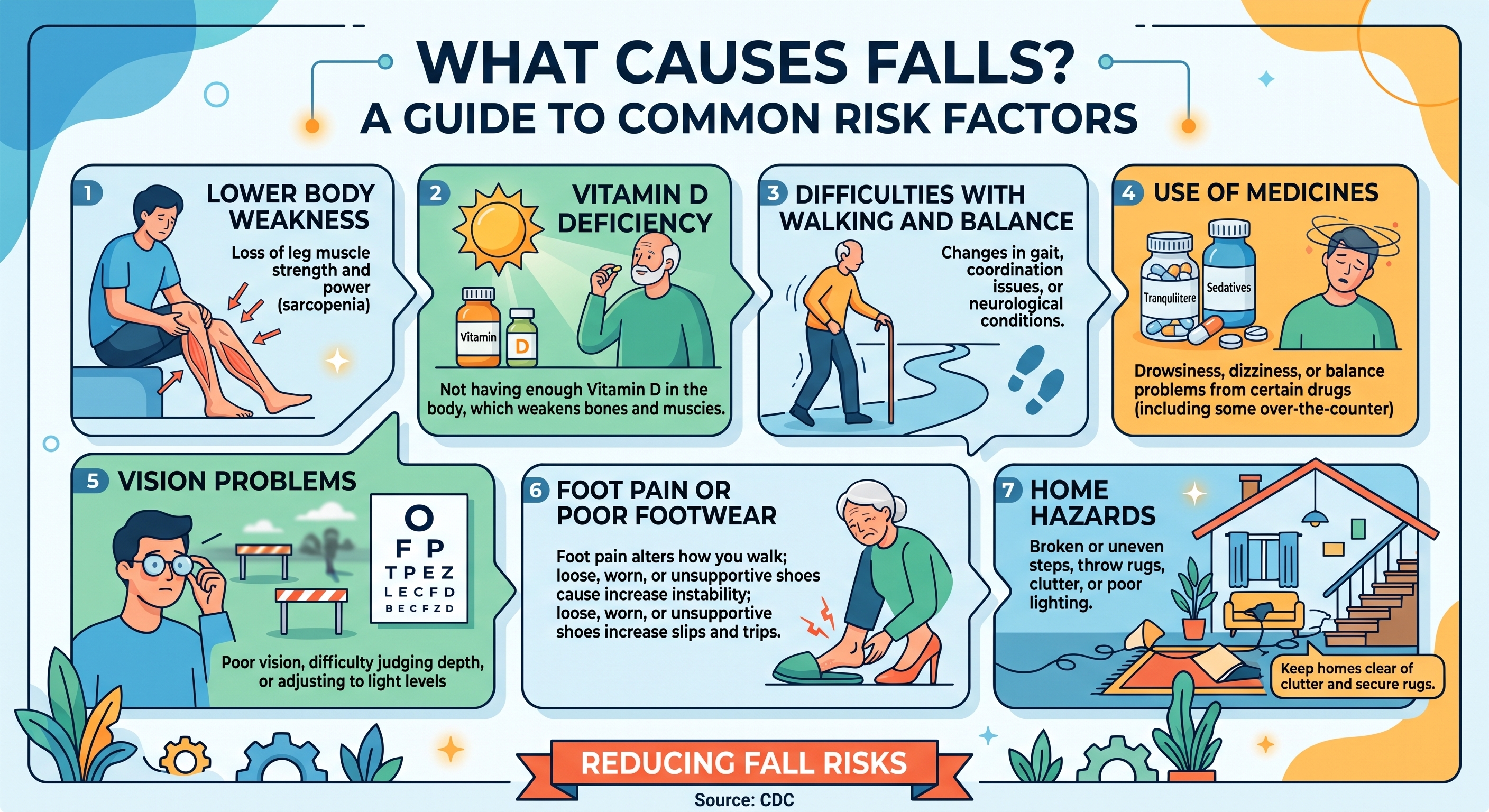
How do we prevent falls or decrease their severity when they happen? Strong bones break less easily because they have more bone mineral density and strength training helps build both muscle and increase bone mineral density.
Look again at the risk factors above: some medications, clutter, poor lighting can be fixed in an afternoon. But the first three (weak legs, poor balance, and the muscle loss underneath them) are the slow, quiet ones. The medical name for that muscle loss is sarcopenia.
Sarcopenia and Muscle Loss
Sarcopenia is the progressive loss of muscle mass, strength and function with age, and a primary driver of falls and functional decline. It begins earlier than most expect and accelerates after 65. As the graph below shows, muscle mass falls steadily from around 30 roughly 3–8% per decade, faster after 60, so a parent can look unchanged while their reserve quietly halves [38].

Figure Legend: Relative skeletal muscle mass across the lifespan (index at age 30 = 100). Illustrative curve based on published loss rates of ~3–8% per decade after 30, accelerating after age 60 [38].
Why falls happen
Sarcopenia, the progressive loss of muscle mass, strength and function with age, can reduce the physical reserve needed to recover from a trip. Muscle mass declines by roughly 3–8% per decade after age 30, with faster loss after age 60 [38]. Previous ankle or knee injuries can affect gait and balance, while pain can lead to less movement, further weakness and greater fall risk [37]. Falls can also be influenced by medications, vision, dizziness, footwear and hazards at home [37].
What happens after a fall
Bone mineral density falls with age, particularly after menopause, increasing fracture risk [35]. After a fall or fracture, reduced activity can contribute to further muscle and bone loss. The risk of a second fracture is highest in the first one to two years after the first [35].
Prevention and Action
Resistance training has improved bone mineral density and physical function in postmenopausal women with osteopenia or osteoporosis [36]. Strength and balance training can support mobility and help reduce fall risk [37]. Medication review, vision, pain, footwear, home hazards and new walking or dizziness problems should also be addressed as part of fall prevention [37].
DXA, also called a DEXA scan, measures bone mineral density. Whether screening is appropriate should be discussed with a clinician based on age, sex, fracture history and individual risk factors [4]. A 2021 meta-analysis estimated sarcopenia in 12.9% of community-dwelling older Chinese men and 11.2% of women [5]. In CrossGen Health’s internal survey of 88 respondents, only 6% of mothers and 8% of fathers reported doing weight training regularly [6]. Sarcopenia is an early warning, not a sentence.
Functional Decline
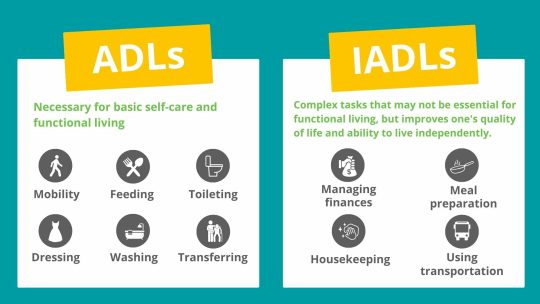
Functional decline means losing the ability to do the everyday things that let someone live on their own, from basic tasks like dressing and bathing, to more complex ones like managing money, medications, and groceries. It often starts with the more complex tasks (IADLs) long before it shows up in basic self-care, which is why a parent can look "fine" while independence is already quietly eroding. Looking at the graph below, we can see the widening range of functional ability in ageing adults.
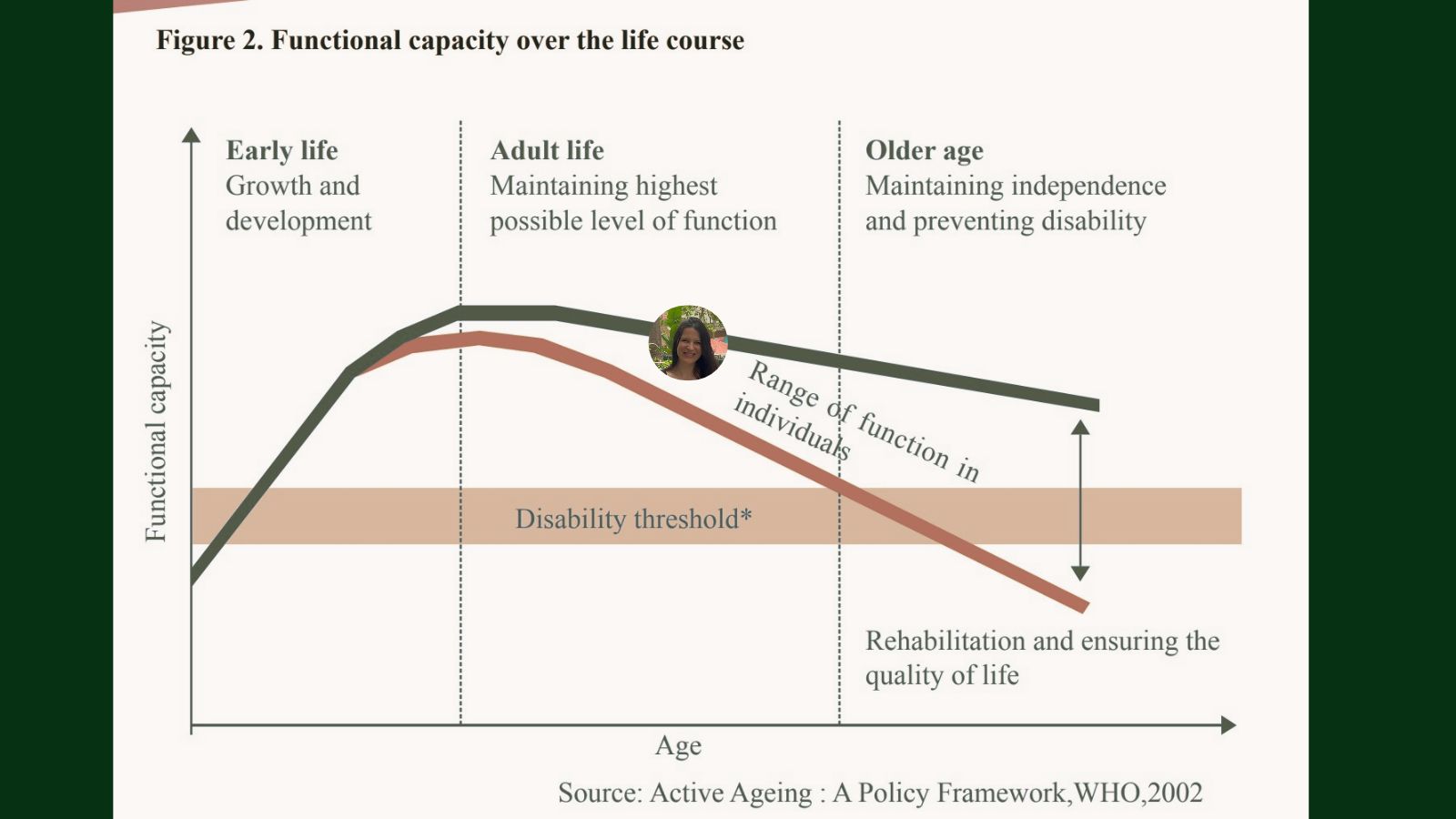
A parent can look independent while functional decline is already happening and measurable. Hong Kong researchers recently built an electronic frailty index from the medical records of more than 1 million older adults, making it possible to track decline at a whole-population level [28]. Community samples estimate that around 14% of the older adults living at home are already frail [29]. CUHK puts the pre-frail share at over 60%, not disabled, but quietly losing reserve [18]. And decline isn't only physical, Hong Kong survey work has found a high prevalence of social frailty isolation and shrinking participation, among older residents [30]. Social isolation itself is closely associated with poorer health status among community-dwelling older adults [31].
And a 14-year Hong Kong prospective study mapped how instrumental activities of daily living (money, medications, housework) erode over time in older men and women, and who declines fastest [32-34].
Where CrossGen Health fits
Functional decline rarely arrives as one obvious event. It may first look like a parent taking longer on the stairs, avoiding walking outside, forgetting a medication change, struggling with groceries, or becoming less confident after a near-fall.
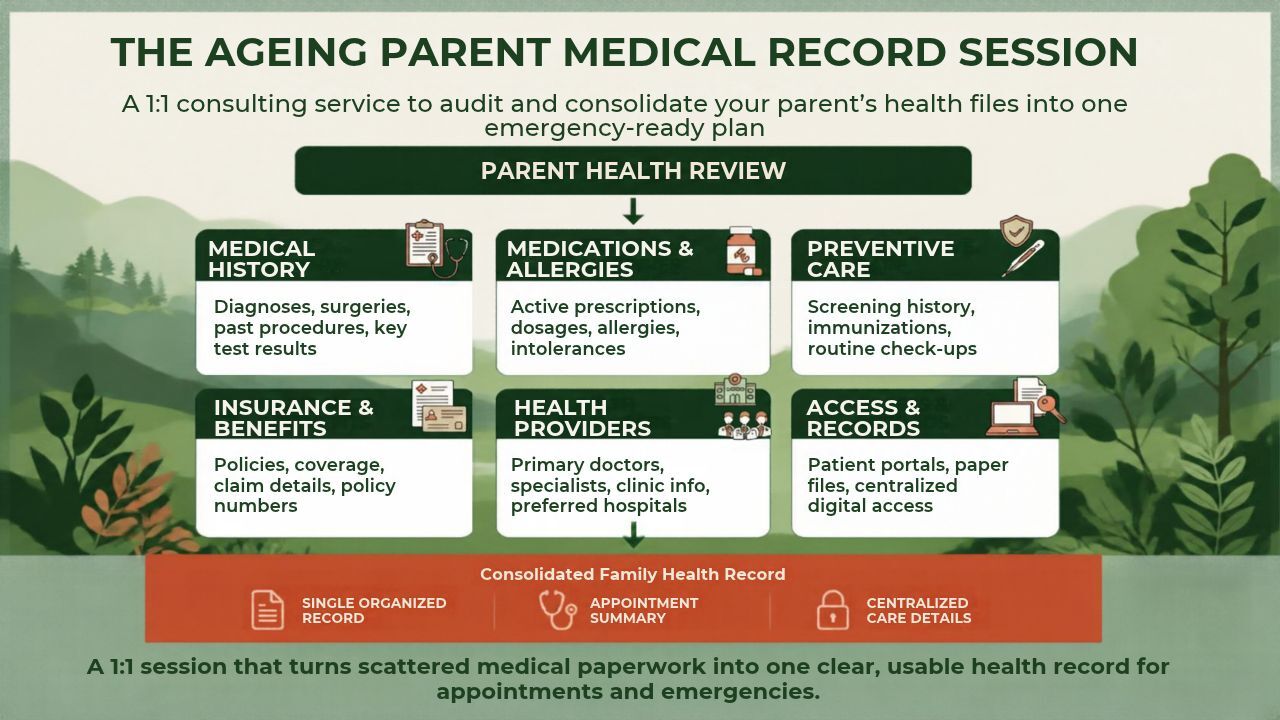
The problem is that these changes are often scattered across family conversations, clinic visits, hospital discharge summaries, specialist referrals and test results. By the time a parent falls or needs urgent care, adult children may be trying to reconstruct what changed, when it changed, which medications they take, what their mobility was like before, and what the next clinical steps should be.
CrossGen Health helps families bring that information into one organised record. We document the baseline in our Medical Documentation session: mobility, daily activities, recent falls or near-falls, medications, diagnoses, scans, referrals, hospital history and care plans. This makes it easier to spot changes earlier, prepare for appointments and give clinicians a clearer picture when something does change. Book a free-20 minute consultation to see if CrossGen Health is a fit for your family.
Sources
1. 30% of hip fracture patients cannot walk again; 25% die within one year. CUHK inTouch. https://cuhkintouch.cpr.cuhk.edu.hk/2020/12/old-folks-fall-more-often-in-care-homes/
2. 15.7% of adults 65+ fell in the past year; 9.8% sustained a fracture. Hong Kong Elderly Health Service (2023). https://www.elderly.gov.hk/english/healthy_ageing/healthy_living/falls.html
3. Over 6,300 hip fractures occur in Hong Kong per year; falls cause 95%+ of them. CUHK inTouch. https://cuhkintouch.cpr.cuhk.edu.hk/2020/12/old-folks-fall-more-often-in-care-homes/
4. DEXA scan recommended to measure bone mineral density in adults 65+. Hong Kong Reference Framework for Preventive Care for Adults over 65+, Health Bureau. https://www.healthbureau.gov.hk/phcc/rfs
5. Sarcopenia in community-dwelling Chinese older adults ~12.9% (men), 11.2% (women). Meta-analysis, Nutrients, 2021. https://www.mdpi.com/2072-6643/13/5/1441
6. Only 6% of mothers and 8% of fathers do regular weight training. CrossGen Health Internal Survey (n=88).
7. Each 1 kg higher grip strength ≈ 3% lower mortality risk. Cited in GeroScience, 2026. https://link.springer.com/article/10.1007/s11357-026-02163-5
8. Unable to complete grip/chair-stand tests = much higher disability and mortality risk. Huang et al., 2024. https://pmc.ncbi.nlm.nih.gov/articles/PMC10938679/
9. 5-year gait-speed and grip-strength trajectories predict mobility, cognition, frailty, mortality. Gore et al., 2025. https://d-nb.info/1382639201/34
10. 16-year HK trajectories of grip, gait and IADL difficulty predict loss of independence. Auyeung et al., 2023. https://www.sciencedirect.com/science/article/pii/S1279770723026179
11. Researchers can identify older adults at risk of accelerated gait decline before falls occur. Lynch et al., 2025. https://www.mdpi.com/2673-9259/5/2/19
12. 16-week resistance training RCT improved resilience, functional fitness, QoL in HK older adults. 2024. https://www.tandfonline.com/doi/full/10.1080/23311908.2024.2426873
13. Resistance training builds strength even in frail older adults. JCSM. https://onlinelibrary.wiley.com/doi/full/10.1002%2Fjcsm.13359
14. Resistance training safe and effective in cognitive frailty. 2025. https://pubmed.ncbi.nlm.nih.gov/40898138/
15. Exergaming with a resistance component improved strength, function and cognition. 2025. https://pmc.ncbi.nlm.nih.gov/articles/PMC13109284/
16. Expert group incl. HK researchers recommends resistance training against frailty. 2021. https://medicalxpress.com/news/2021-10-experts-resistance-frailty-elderly.html
17. HK trial testing combined aerobic + resistance training to build physical reserve. ClinicalTrials.gov. https://clinicaltrials.gov/study/NCT07513701
18. Over 60% of HK elders pre-frail; >80% of pre-frail reversed to robust. CUHK press release. https://www.med.cuhk.edu.hk/press-releases/multicomponent-frailty-prevention-programme-reduces-frailty-over-80-of-pre-frail-elderly-reverse-to-robust-phenotype
19. Older adults with chronic musculoskeletal pain are less active; physical activity prevents and treats pain. Systematic review, 2022. https://pmc.ncbi.nlm.nih.gov/articles/PMC9684997/
20. Exercise reduces the severity of chronic pain. Overview of Cochrane Reviews, 2017. https://pmc.ncbi.nlm.nih.gov/articles/PMC5461882/
21. Physical activity programme effective for managing chronic pain and preventing frailty vs usual care. BMC Geriatrics, 2020. https://link.springer.com/article/10.1186/s12877-020-01805-3
22. 12-week Tai Chi improved pain and gait, reduced fall risk, in older adults with multisite pain. 2018. https://pmc.ncbi.nlm.nih.gov/articles/PMC6126990/
23. Tai Chi associated with modest pain reduction in knee OA. Meta-analysis, 2026. https://www.frontiersin.org/journals/pain-research/articles/10.3389/fpain.2026.1678660/full
24. Resistance training effective for pain, strength and function in knee and hip OA. Meta-analysis, 2024. https://pmc.ncbi.nlm.nih.gov/articles/PMC11676110/
25. RT moderately-to-highly effective for OA pain relief (U-shaped dose curve). 2025. https://www.frontiersin.org/journals/public-health/articles/10.3389/fpubh.2025.1623679/full
26. Walking and resistance training both effective against chronic low back pain. 2023. https://pmc.ncbi.nlm.nih.gov/articles/PMC10684243/
27. Tai Chi and yoga alleviate chronic pain but are not superior to traditional exercise. Meta-analysis, 2023. https://www.sciencedirect.com/science/article/abs/pii/S0197457223002859
28. Electronic frailty index built from 1M+ Hong Kong older adults' records. Auyeung et al., J Frailty Aging, 2025. https://pmc.ncbi.nlm.nih.gov/articles/PMC12184025/
29. ~14% of community-dwelling older adults in Hong Kong are frail. Meta-analysis, 2019. https://pubmed.ncbi.nlm.nih.gov/31021361/
30. High prevalence of social frailty among older people in Hong Kong. MDPI, 2023. https://www.mdpi.com/2673-9259/4/3/16
31. Social isolation associated with poorer health status in community-dwelling older adults. Wong et al., 2023. https://scholars.cityu.edu.hk/en/publications/association-of-social-isolation-with-health-status-among-communit/
32. Elevated ADL-related functional impairment among Chinese elderly is a growing care burden. China CDC Weekly, 2023. https://weekly.chinacdc.cn/en/article/doi/10.46234/ccdcw2023.114
33. Functional impairment varies significantly across China's six regions. BMJ Open, 2025. https://bmjopen.bmj.com/content/15/2/e088955
34. 14-year HK prospective study: IADL trajectories and predictors in older men and women. Lu et al., 2025. https://pmc.ncbi.nlm.nih.gov/articles/PMC11854970/
35. Bone remodelling, peak bone mass, postmenopausal bone loss, osteopenia/osteoporosis thresholds, calcium, vitamin D, protein, lifestyle and corticosteroid effects, immobilisation bone loss, and imminent refracture risk after a prior fracture. LeBoff et al., \"The Clinician's Guide to Prevention and Treatment of Osteoporosis,\" Osteoporosis International, 2022. https://doi.org/10.1007/s00198-022-06364-4
36. High-intensity resistance and impact training improves bone mineral density and physical function in postmenopausal women with osteopenia and osteoporosis (LIFT-MOR randomised controlled trial). Watson et al., Journal of Bone and Mineral Research, 2018. https://doi.org/10.1002/jbmr.3352
37. World guidelines for falls prevention and management in older adults: prior injury, gait and balance as fall risk factors; balance and strength training as prevention. Montero-Odasso et al., Age and Ageing, 2022. https://doi.org/10.1093/ageing/afac239
38. Muscle mass declines ~3–8% per decade after 30, faster after 60; up to ~50% lost by the eighth decade. Narrative review, J Yeungnam Med Sci, 2023. https://www.e-jyms.org/journal/view.php?number=2806